
by Kate Maruyama
I have been a volunteer with CLUE since August of 2025. I’d been so frustrated by the ICE roundups terrorizing the city since June, and felt helpless in the hugeness of it. 30-60 people a week were being rounded up in the Los Angeles area. I’m older and dealing with arthritis, so patrolling Home Depot to film ICE activities was out and demonstrating is no longer agreeable for my body. My writer friend Lisa Cheby told me about CLUE, and Désirée Zamorano, a fellow writer, filled me in. I signed up with CLUE and their sister partner, AVAN, an organization that arranges visits to prisoners at Adelanto. I went to a training at CLUE and one court observation before I went to Adelanto, but it was my first visit to the detention center when the larger cruelty of the system clicked into place for me.
At Adelanto when we visit we’re not allowed to bring anything in, even notebooks. The most we can provide is companionship, conversation, and if we can memorize some phone numbers, reaching out to someone for the prisoner (I use prisoner here instead of detainee because let us be honest about what’s going on there) and passing on a message. It’s a vital service and every few months, I get together with writer friends and we visit again. It also lets us bear witness to the system and learn what things are like for those inside.
We visited the building where everyone wears navy blue scrubs, which indicates they have never been convicted of even a misdemeanor. We learned through our conversations that these were all people who held jobs, paid their taxes, worked every day, and were vital to their family networks. What was impressed upon me in these visits is that it’s not one person being damaged by incarceration, it’s all the people in their lives who count on them. We talked to fathers, grandfathers, brothers, husbands, people who were separated from small children, spouses worried about their wives caring for their families without the benefit of their income, about jobs likely lost as they’d been locked up for five or six months. We heard from prisoners having no ability to contact the right people to get all of the paperwork in line they needed for a bond hearing – three letters of recommendation from citizens, tax receipts, and other papers to prove that they should not have been locked up in the first place. Getting a hold of that information is nigh on impossible with 60 men in a room with two iPads to share for communication. These people were presumed guilty until proven innocent.
I went back to court observation, the work there felt vital and I had a firm grip on what I was helping people avoid. On good days, I would process a bond with a check from CLUE’s bond fund. I know that by sitting in the ICE office, processing paperwork, by the end of the day someone will be going home from a detention center. Every bond that processes gives me some measure of joy.
One Wednesday I joined Bill C, another CLUE volunteer, a Buddhist, and we accompanied a woman to her ICE check-in. It was my first time in the basement of the North Los Angeles Courthouse, a large windowless room lined with over 150 plastic chairs was full of people waiting to check in with their agents under flickering fluorescent lights and carpets that had likely been put in decades before. Wait times are three to seven hours and those with appointments must be on time, and most need to miss work to be there.

The woman we were accompanying was seen after three hours. She had a lawyer with her, and the clerk called up a translator on speakerphone. He told this woman she had six infractions on her record and she could be detained or deported. She was here on asylum and needed to answer the phone whenever the office texted her. Something had happened so that she hadn’t received the texts. She responded that, aside from one time she was unconscious in surgery, she had answered the phone calls that followed. They counted the times she had not received the texts (which was for some technical reason) as infractions, including the time she was unconscious.
It was then that I saw the power of CLUE’S accompaniment. The clerk was adamant and spoke threateningly about “next steps.” But I could see him clocking me and Bill sitting there with them and perhaps because it’s very hard for me to control my face when someone is being absurd, he backpedaled a bit and had us wait outside. When we reentered the room his tone had changed. He made the woman swear she would answer texts in the future, they corrected her number in their system, erased the infractions, and let her off with a warning. I really do wonder what her check in would have been like if there wasn’t a lawyer and two white people there. I do believe it would have gone differently.
Most Wednesdays I observe court proceedings, taking note of things as they change, and how the procedures seem to change every month as DHS changes laws and moves the goalposts. I take notes and report back to CLUE’s amazing volunteer organizer Jennifer Coria. One important thing about showing up every Wednesday is continuity so you can develop an ear for irregularities. CLUE always needs more volunteers.
Another morning I had an accompaniment case for a seven-year-old. This happens when the child’s family asks for someone to sit with them in court, whether to help them feel they have someone at their side, or to have someone to make sure the child understands what is happening or to sit with them in faith. It’s an important job. The child’s grandmother who was about my age came, along with her boyfriend’s daughter, who was in her twenties and fluent in English. The boy was small, and had the giantest ears. It was hard not to see my son at that age, so well behaved, so vulnerable, scared but doing his best to do right by his grandma. It broke my heart even thinking that he had an individual case. The family met me in line outside the courthouse, and I asked if the grandmother had a case in the works, because I had seen judges combine cases so the kid doesn’t have to appear alone. She said they did her case while she was in a detention center and that broke my heart further. This kid did not have his mom around, and his grandmother had been taken from him.
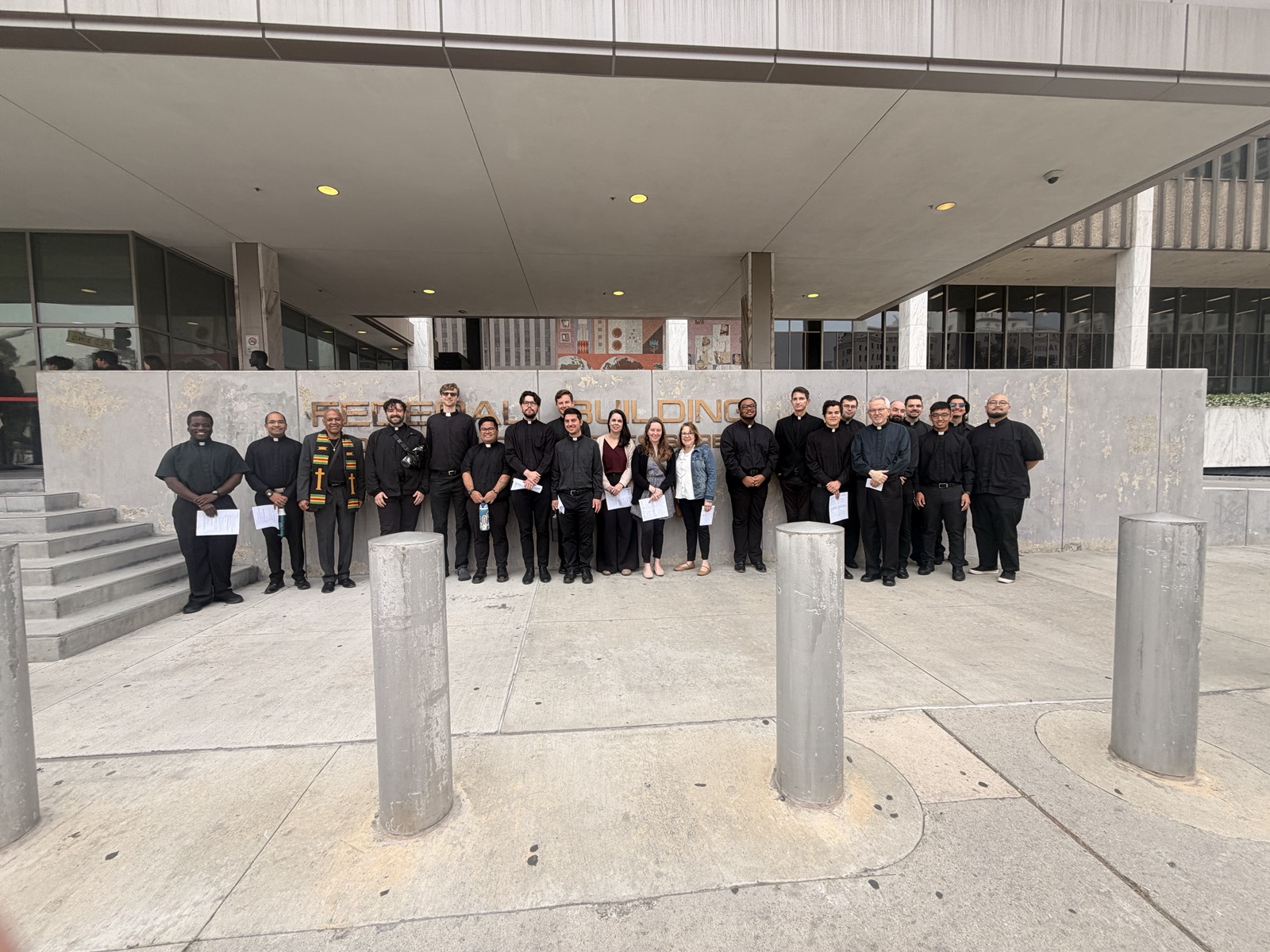
As I approached the courthouse that morning, I saw our dear Jennifer Coria doing a training surrounded by twenty three Jesuit priests in collars. It was such a beautiful thing to see, this young person so fully in charge of her mission there, and all the priests listening intently to her instructions. The priests got in line for the courthouse behind us. The family was running a bit late, so we dashed up to the courtroom once we were through security and went into the courtroom. I sat behind the family, my gaze focused on the little seven-year-old with the big ears sitting so straight and quiet when he should, at this hour by all rights, be running around the schoolyard yelling his head off.
The door opened behind me and there was a shuffling as all twenty three priests entered the courtroom and sat in rows behind this boy and his family. I tried very hard not to grin as I knew what it must look like, this one child with his case with 23 representatives of God at his back.
This Judge is as kind as she can be with the kids in her courtroom. She makes sure they understand what is going on and quite often if they are younger, lets them know they do not have to appear in court if there is a representative there for them. And she shows that she knows they’ve missed school.
The boy was given a few months to find a lawyer, which compared to other cases, felt like a long window. Some people only get a few weeks in which to secure a pro bono lawyer, which is hard as they are overwhelmed by cases. I warned the family they couldn’t expect all the priests next time, but I or another member of CLUE would be happy to be there for them.
A few weeks later, I got the good news from Jennifer that CLUE had reached out to IMDEFF (Immigrant Defenders Law Center) and got a lawyer to represent the boy. My hope is that he never has to sit in a courtroom again and can continue to live his life with his family.
Some people find court proceedings slow, or feel there isn’t a point in going if nothing very big happens. But in the instances I can point someone to pro bono legal aid, accompany them to their car or public transportation, I know that even my presence as a sympathetic face in the courtroom is doing some good. I know that this work, little by little, is at least helping a bit. For people caught in this cruel and shifting immigration system, court observers can show that at least somebody has their back, and that we recognize what is going on. When someone who has never done a crime has to stop for a security check going to his court date because he has an electronic GPS monitoring bracelet on his ankle, at least I can say to him, “I’m sorry.”
Kate Maruyama is a novelist and an adjunct professor in Creative Writing at Cal State LA, University of LaVerne and Antioch University Los Angeles. You can learn more about her fiction at katemaruyama.com